Box breathing: a simple 4-4-4-4 guide
Not medical advice.
6 min read
Box breathing is a steady, even pattern that is easy to remember. Picture a square with four equal sides. You spend the same length of time on each side of it.
What box breathing is
You breathe in for four counts, hold for four, breathe out for four, and hold again for four. That is one round. The pattern is balanced and predictable, which makes it a good choice when you want to feel level and focused, for example before a meeting or when you are feeling scattered.
Because every side of the box is the same length, there is very little to think about. You do not need to remember different numbers, and that simplicity is part of its appeal. Many people find it easier to stay with than patterns with a long hold.
Step by step
Sit upright with your feet on the floor and your shoulders soft.
- Breathe out gently to empty your lungs.
- Breathe in through your nose for a slow count of four.
- Hold, gently, for a count of four.
- Breathe out through your nose or mouth for a count of four.
- Pause with your lungs empty for a count of four.
- Repeat for four rounds, then breathe normally.
A helpful trick is to picture a square. As you breathe in, move up one side. As you hold, go across the top. As you breathe out, come down the other side. As you pause, travel along the bottom.
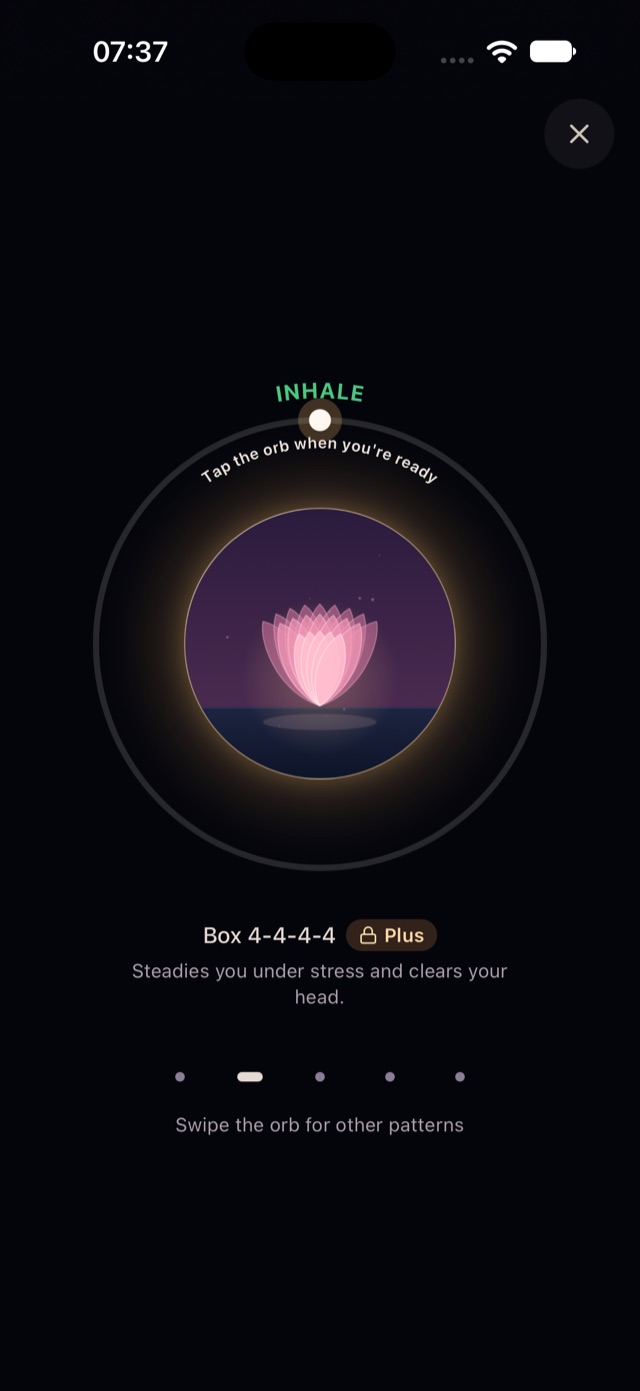
You can follow along with the breathing timer by choosing the box pattern.
When box breathing is a good fit
Because it is steady and even, box breathing suits moments when you want to feel level rather than sleepy. Some good moments to try it:
- Before a meeting, call or exam. Two or three rounds can help you arrive.
- After a rush. When you have been hurrying, a few rounds help you slow down without feeling flat.
- When you feel scattered. The counting gives your attention a single clear task.
- During a break. One or two minutes with your eyes on a window or a wall.
If you want something to help you wind down for sleep, a pattern with a longer exhale, such as 4-7-8, may suit you better.
Common mistakes
Pulling too much air in. A smooth, quiet breath is enough. If your shoulders rise, ease off.
Holding with tension. The pauses should feel like stillness, not like gripping. Keep your face and hands relaxed.
Counting too fast. If you rush, the pattern turns into a chore. A slow, even count keeps it calm.
Skipping the last pause. The pause after the out-breath is the part people tend to leave out. If it feels uncomfortable, make it shorter, but try to keep a small gap before the next breath.
Adjusting it for you
If four counts feels long, use three. If it feels too easy and you want more, you can move to five or six, but keep all four sides equal. Stop if you feel lightheaded, and return to normal breathing. If it happens often, speak to a professional.
Some people find the empty-lung pause uncomfortable. If that is you, try a gentler version: breathe in for four, hold for two, breathe out for four, and skip the final pause. Make it your own.
Pairing it with other habits
Box breathing sits nicely beside the other small tools on this site. Use it at the start of a five-minute reset, then let your breathing return to normal. In the evening, a few rounds can lead into a wind-down routine.
If you keep a mood journal, a quick note after a session, such as "calmer" or "same", helps you see when it really works for you. There is no need to make it a ritual. A word is enough.
A starter plan
For one week, try four rounds when you start your work, or when you sit down on the train. Notice how you feel afterwards: just a note, no score. Many people find that the exercise is most useful when it is already a habit before the day gets hard.
In the second week, try it once in a moment of mild stress, such as before opening a difficult email. You may find that the habit is there when you need it.
Box breathing for different situations
At your desk. Keep your eyes open, and trace the edge of your monitor as you count. No one will notice.
Before sleep. Lengthen the exhale slightly, to five or six, and let your body sink into the bed.
In a queue. Count on the fingers of one hand, a finger for each count, so you always know where you are.
When you feel a flash of frustration. Do one slow round before replying. The pause is often all you need to answer more kindly.
A note
Box breathing is a small everyday tool. It is not a medical exercise, and it is not a substitute for professional advice. If you have a breathing or heart condition, check with a doctor before starting any breathing exercise.
Common questions
What is the difference between box breathing and 4-7-8?
Box breathing uses even counts with a pause after each breath. 4-7-8 has a longer hold and a much longer out-breath. Many people find box breathing steadier and 4-7-8 more relaxing.
Can I do it with my eyes open?
Yes. Some people like to trace a square with their eyes, along the edge of a window or a screen, as they count.
Is four seconds too long for me?
Not at all. Use three, or even two, and keep the counts equal. Comfort matters more than the number.
Try this in Aama
Breathing exercises, sleep sounds and a mood journal, in one quiet app for your phone. No ads inside.
Feeling unsafe? Get help now
Related guides
A slow 10-minute morning routine
A gentle way to start the day without grabbing your phone first: water, light, a few breaths and one intention.
Read the guide →4 min readThe 5-4-3-2-1 grounding exercise, step by step
Use your five senses to come back to the present moment. A simple, quiet exercise for when your mind is racing or spinning.
Read the guide →